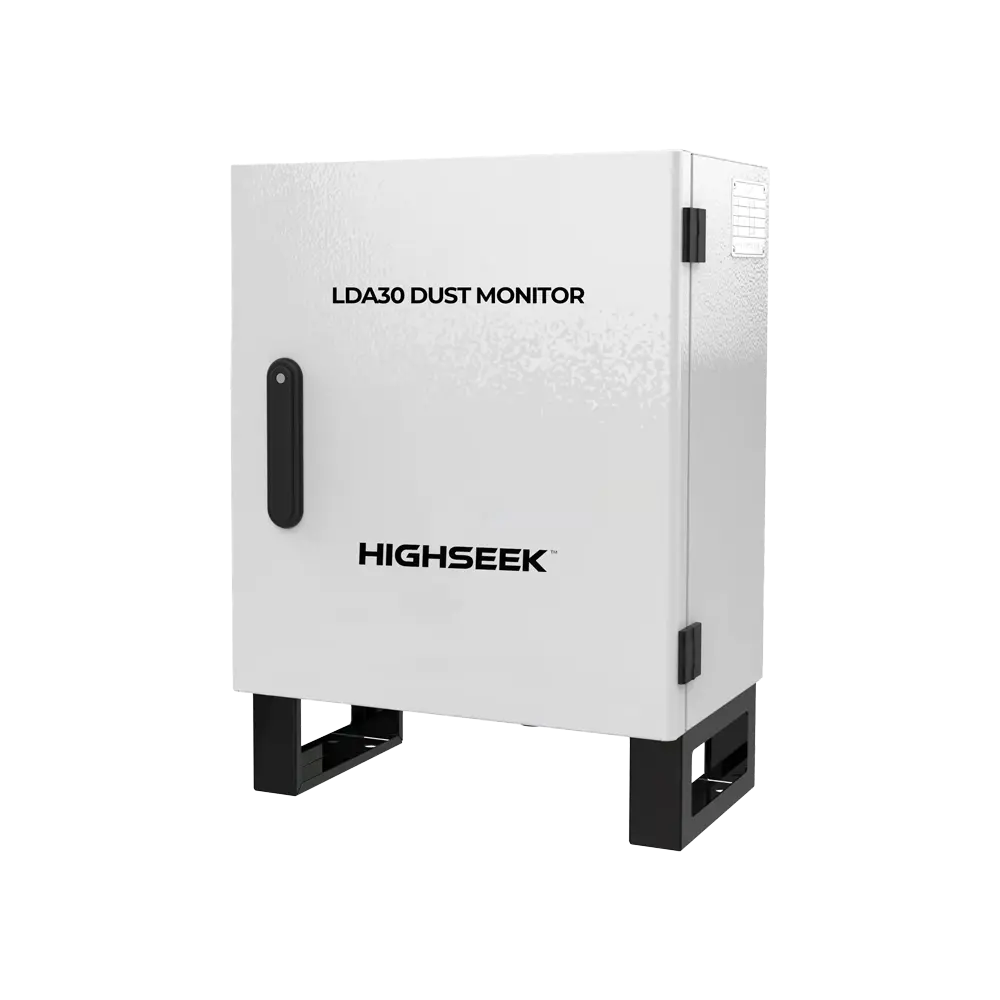
LDA30 Extractive Ultra-Low Dust Monitor | HighSeek
Product Overview
The LDA30 Extractive Ultra-Low Dust Monitor is designed for continuous measurement of low-concentration particulate matter in industrial flue gas and emission monitoring applications.
Based on laser scattering technology, the LDA30 uses a high-temperature extractive sampling design to collect flue gas from the measurement point and deliver it to an integrated optical measurement unit. This approach enables continuous dust concentration monitoring under demanding industrial operating conditions, particularly in applications requiring ultra-low emission measurement.
The analyzer features imported core components and a compact, integrated measurement structure. Its specialized short optical path design supports sensitive particulate matter measurement without requiring optical path adjustment for different flue configurations.
An air-curtain purging system helps protect the optical windows from dust contamination while maintaining relatively low compressed air consumption. With no moving parts in the measurement system, the LDA30 offers a simplified structure, reduced maintenance requirements, and fast measurement response.
The LDA30 can operate as an independent dust monitoring instrument or be connected with multiple units to form a distributed particulate matter monitoring network. Centralized data acquisition and processing enable coordinated monitoring across multiple emission sources.
Key Features and Advantages
1. Ultra-Low Dust Concentration Measurement
Designed for low-concentration particulate matter monitoring, the LDA30 offers a measurement range of 0–10 mg/m³ and a specified detection limit of 0.05 mg/m³.
Its high-sensitivity optical measurement system is suitable for industrial emission monitoring applications where accurate measurement of low dust concentrations is essential.
2. Extractive High-Temperature Sampling
The LDA30 uses an extractive sampling configuration with controlled sample heating.
Compared with conventional in-situ dust monitoring, the extractive design helps reduce the influence of fluctuations in flue gas temperature and pressure on the measurement process. It also provides a more controlled environment for optical measurement and supports online calibration.
3. Low-Consumption Air-Curtain Purging System
A specially designed air-curtain purging system protects the optical windows from particulate contamination.
The system requires approximately 10 L/min of compressed air, helping reduce purge air consumption compared with conventional optical dust monitoring systems that may require substantially higher air supply rates.
This design helps maintain optical cleanliness while reducing the operating demand on the compressed air supply.
4. Ambient Light Interference Suppression
The LDA30 incorporates a specialized optical structure designed to minimize the influence of external ambient light on the measurement signal.
This feature supports reliable optical measurement in different installation environments, including locations where ambient light conditions may vary.
5. Short Optical Path Design
The analyzer uses a specialized short optical path structure to perform particulate matter measurement without requiring optical path adjustment for different flue configurations.
This design simplifies installation and commissioning while supporting consistent measurement performance.
6. No Moving Parts for Improved Reliability
The integrated measurement system contains no moving mechanical components.
Unlike some conventional extractive sampling systems, the LDA30 does not require a diaphragm sampling pump, external condensation unit, or long heated sampling line as part of its stated configuration.
Its simplified structure helps reduce the number of wear-prone components and supports reliable continuous operation.
7. Fast Response and Online Calibration
With a specified response time of no more than 10 seconds, the LDA30 provides rapid feedback on particulate matter concentration changes.
Its extractive measurement design also supports online calibration, helping simplify routine instrument verification and maintenance.
8. Flexible Communication and System Integration
The LDA30 supports 4–20 mA analog output and RS485 digital communication using the standard Modbus protocol.
Individual instruments can operate independently or be networked together through a centralized data acquisition and processing platform for multi-point dust monitoring.
Working Principle
Extractive Laser Scattering Measurement
The LDA30 uses laser scattering technology combined with an extractive sampling system to measure particulate matter concentration in industrial flue gas.
A sampling probe collects representative flue gas from the duct or stack. The extracted sample is transported to the analyzer’s optical measurement chamber, where it interacts with a laser beam.
When the laser beam encounters suspended dust particles, light is scattered by the particles. The optical detection system collects the scattered light and converts the resulting signal into an electrical measurement signal.
The analyzer processes the optical signal through its measurement and calibration algorithms to determine the corresponding particulate matter concentration.
The LDA30 incorporates a specialized short optical path structure and an air-curtain purging system to help maintain optical measurement stability and minimize contamination of the optical windows.
The extractive sampling configuration provides a controlled measurement environment and supports online calibration, making the instrument suitable for continuous monitoring of ultra-low dust concentrations in industrial emission applications.
Technical Specifications
| Parameter | Specification |
|---|---|
| Product Model | LDA30 |
| Product Type | Extractive Ultra-Low Dust Monitor |
| Measurement Principle | Laser Scattering |
| Measurement Method | Extractive Sampling |
| Measurement Parameter | Particulate Matter / Dust Concentration |
| Measurement Range | 0–10 mg/m³ |
| Detection Limit | 0.05 mg/m³ |
| Indication Error | <±15% F.S. |
| Zero Drift | ≤±2% F.S. / 24 h |
| Span Drift | ≤±2% F.S. / 24 h |
| Response Time | ≤10 s |
| Laser Wavelength | 650 nm |
| Laser Output Power | 20 mW |
| Sample Heating Temperature | 120–150 °C |
| Maximum Flue Gas Temperature | <300 °C |
| Flue Gas Pressure | -2.5 to +2.5 kPa |
| Sampling Probe Diameter | 3 mm, 6 mm, 8 mm (customizable) |
| Analog Output | 1 × 4–20 mA |
| Digital Communication | RS485, Modbus RTU |
| Relay Output | 1 passive relay output, 2 A / 30 V |
| Communication Settings | 9600 baud (default), 8 data bits, 1 stop bit, no parity |
| Power Supply | 220 VAC |
| Power Consumption | 500 W |
| Ingress Protection Rating | IP54 |
| Operating Ambient Temperature | -10 to 50 °C |
| Approximate Weight | 30 kg |
Typical Applications
The LDA30 is suitable for continuous particulate matter monitoring in industrial exhaust gas and emission control systems, particularly where low dust concentration measurement is required.
1. Thermal Power Plants and Industrial Boilers
- Ultra-low dust emission monitoring in thermal power plants
- Particulate matter measurement in boiler exhaust systems
- Dust concentration monitoring after electrostatic precipitators and bag filters
- Performance evaluation of industrial dust removal equipment
- Continuous monitoring of particulate emissions from industrial boilers
2. Steel and Metallurgical Industries
- Dust emission monitoring in steelmaking processes
- Particulate matter monitoring in metallurgical furnaces
- Dust concentration measurement in industrial exhaust ducts
- Evaluation of flue gas purification and dust removal systems
3. Cement and Building Materials Industries
- Low-concentration dust monitoring in cement production facilities
- Particulate emission monitoring in rotary kiln exhaust systems
- Dust monitoring after bag filters and other dust collection equipment
- Emission monitoring in ceramics and building materials manufacturing
4. Petrochemical and Chemical Industries
- Particulate matter monitoring in industrial exhaust systems
- Dust emission monitoring in chemical production facilities
- Continuous monitoring of particulate emissions from process equipment
- Integration with industrial environmental monitoring systems
5. Waste Incineration Plants
- Dust emission monitoring in waste incineration flue gas
- Particulate concentration monitoring after flue gas treatment
- Performance evaluation of dust removal equipment
- Continuous emission monitoring and environmental management
6. Flue Gas Desulfurization and Dust Removal Systems
- Particulate matter monitoring before and after flue gas treatment equipment
- Dust concentration monitoring in desulfurization systems
- Performance assessment of particulate removal processes
- Integration with CEMS for centralized emission monitoring
Why Choose the LDA30 Extractive Ultra-Low Dust Monitor?
The LDA30 combines extractive sampling, laser scattering measurement, and a specialized optical design to provide continuous monitoring of low-concentration particulate matter in industrial flue gas.
Its high-sensitivity measurement capability, low-consumption air-curtain purging system, short optical path, and simplified mechanical structure make it a practical solution for ultra-low dust emission monitoring.
With fast response, online calibration capability, and flexible RS485 and 4–20 mA interfaces, the LDA30 can be integrated into individual emission monitoring installations or multi-point dust monitoring networks.
For industrial operators and CEMS system integrators, the LDA30 provides a reliable monitoring solution for emission control, dust removal performance evaluation, and environmental compliance management.