

Gas Detection for Battery Energy Storage Systems (BESS): A Practical Guide
Battery Energy Storage Systems (BESS) play an increasingly important role in renewable energy integration, grid stability, peak shaving, and backup power applications. As battery installations grow in size and complexity, effective safety monitoring has become a key consideration for system designers, operators, and project developers.
One important part of a comprehensive BESS safety strategy is gas detection. Under certain abnormal conditions, lithium-ion batteries can release gases as a result of electrolyte decomposition, overheating, internal damage, or thermal runaway. Detecting relevant gases early can provide valuable information about developing faults and support timely investigation and emergency response.
In this guide, we explain why gas detection matters in BESS installations, which gases may require monitoring, how to select suitable detectors, and what to consider when designing a battery gas detection system.
1. Why Is Gas Detection Important for BESS?
Lithium-ion battery systems store large amounts of energy in a relatively compact space. Although properly designed and operated battery systems are widely used, failures involving overheating, electrical faults, mechanical damage, or internal cell defects can create hazardous conditions.
Depending on the battery chemistry, failure mechanism, and operating conditions, these events may release combustible, toxic, or asphyxiating gases.
A suitable gas detection strategy can help operators identify abnormal atmospheric conditions and initiate appropriate actions before a situation escalates.
Key benefits include:
- Early warning: Detect selected gases that may indicate abnormal battery conditions.
- Fire and explosion risk management: Identify combustible gas accumulation where relevant to the battery design and risk assessment.
- Personnel protection: Monitor hazardous atmospheres in battery rooms, containers, and associated equipment spaces.
- System integration: Transmit alarms to the battery management system (BMS), energy management system (EMS), building management system (BMS), or fire and safety control systems where appropriate.
- Operational visibility: Support continuous monitoring and alarm-event records for maintenance and investigation.
Gas detection should be considered part of a layered safety strategy. It does not replace battery management, thermal monitoring, fire detection, ventilation, or engineered fire protection.
2. Which Gases Should Be Monitored in Battery Energy Storage Systems?
The appropriate target gases depend on battery chemistry, cell construction, enclosure design, ventilation, and the hazards identified by the project risk assessment.
There is no single gas detector that is suitable for every BESS application.
Hydrogen (H2)
Hydrogen may be released during certain battery failure conditions. It is highly flammable and can accumulate in enclosed or poorly ventilated areas.
Hydrogen detection may be appropriate where the battery design and hazard assessment identify hydrogen accumulation as a credible risk.
Detector selection should consider the expected concentration range, response time, environmental conditions, and the possibility of gas accumulation in the installation.
Carbon Monoxide (CO)
Carbon monoxide can be generated during certain battery decomposition and thermal runaway events. It is also associated with other combustion processes.
CO monitoring may contribute to a broader battery safety monitoring strategy, depending on the system design and the intended warning function.
Volatile Organic Compounds (VOCs)
Some lithium-ion battery failure conditions can release volatile organic compounds originating from electrolyte components and their decomposition products.
VOCs may be relevant to early abnormal-condition monitoring. However, a general VOC detector does not identify every individual compound, and sensor response can vary depending on the gas mixture.
For this reason, the selected detection technology should match the intended application and validation requirements.
Hydrogen Fluoride (HF)
Hydrogen fluoride may be generated when certain fluorine-containing battery materials or electrolytes decompose under specific conditions.
HF is highly hazardous and corrosive. Where the risk assessment identifies HF as a relevant hazard, the detection method must be selected for the required sensitivity, environmental conditions, and compatibility with the expected atmosphere.
Other Target Gases
Depending on the battery chemistry and installation, other gases may also be relevant. The target list should be based on credible failure scenarios and documented engineering analysis rather than a generic list applied to every project.
Important: Gas selection must be validated against the actual battery technology and the required detection objective. A detector intended to monitor combustible gas may not be suitable for toxic-gas monitoring or early warning of battery off-gassing.
3. Where Should Gas Detectors Be Installed in a BESS?
HighSeek Gas Detector placement is a critical part of system design. Installing a detector in the wrong location may delay detection or produce unreliable results.
The following areas may need evaluation during the engineering design stage.
Battery Containers and Enclosures
Containerized BESS installations may require gas monitoring within battery enclosures, depending on the design, ventilation arrangement, and identified hazards.
Engineers should evaluate potential gas release locations, enclosure geometry, air movement, and possible accumulation zones.
Battery Rooms
Indoor battery installations may require monitoring at selected locations based on room layout, ventilation, battery arrangement, and the properties of the target gases.
The number and location of detectors should be determined through a documented design process.
Ventilation and Exhaust Areas
Ventilation outlets and exhaust paths may be relevant monitoring locations where gas movement and accumulation scenarios have been assessed.
However, placing a detector directly in an exhaust duct or near an airflow source is not automatically the best solution. The location must suit the detection objective and the characteristics of the gas.
Electrical and Control Equipment Areas
Where gas could migrate into adjacent spaces, engineers should evaluate whether additional monitoring is required to protect personnel and equipment.
Detector placement should also account for maintenance access, environmental exposure, and the possibility of interference from other substances.
Key Installation Considerations
Before finalizing detector locations, evaluate:
- Gas density and dispersion behavior under actual site conditions.
- Potential release points and enclosure geometry.
- Ventilation patterns and possible stagnant zones.
- Ambient temperature, humidity, dust, and corrosive exposure.
- Sensor response time and measurement range.
- Calibration, inspection, and replacement access.
- Electrical installation requirements and hazardous-area classification, where applicable.
There is no universally correct detector height or spacing for all battery installations. Final locations should follow the project risk assessment, applicable standards, and detector manufacturer’s instructions.
4. How to Choose the Right Gas Detector for BESS
Selecting a suitable gas detector involves more than choosing the target gas. The detection objective, environment, output requirements, and maintenance strategy must also be considered.
Step 1: Define the Detection Objective
Determine whether the system is intended for early abnormal-condition warning, combustible gas monitoring, toxic gas monitoring, personnel protection, or a combination of these functions.
Different objectives may require different sensors and measurement technologies.
Step 2: Select the Target Gas and Sensor Technology
Confirm the gases that must be detected and evaluate the available sensor technologies.
Depending on the application, technologies may include electrochemical sensors, infrared sensors, catalytic sensors, or other application-specific methods.
Each technology has different strengths, limitations, cross-sensitivity characteristics, and maintenance requirements.
Step 3: Determine the Required Measurement Range
The measurement range should match the expected concentration and alarm strategy.
Consider the required resolution, response time, operating conditions, and the alarm thresholds established by the engineering risk assessment.
Avoid selecting a detector based on measurement range alone.
Step 4: Check Environmental and Installation Requirements
For containerized or outdoor installations, evaluate enclosure protection, temperature limits, humidity, vibration, corrosion, and the required hazardous-area approvals.
Confirm that the complete detector configuration is suitable for the intended location.
Step 5: Confirm Output and Integration Requirements
A BESS gas detection system may need to communicate with a local alarm panel, PLC, SCADA system, or site-wide safety monitoring platform.
Depending on the project, relevant interfaces may include 4–20 mA, relay outputs, Modbus, or wireless communication.
Always verify the interfaces supported by the selected model. Communication compatibility should be confirmed before equipment procurement.
Step 6: Consider Maintenance and Lifecycle Costs
Evaluate calibration requirements, sensor replacement intervals, spare-part availability, service access, and the cost of maintaining the system throughout its operating life.
A suitable Gas detector should provide the required performance while remaining practical to inspect, test, and maintain.
5. Fixed Gas Detection vs. Portable Gas Detection for BESS
Fixed and portable gas detectors serve different purposes.
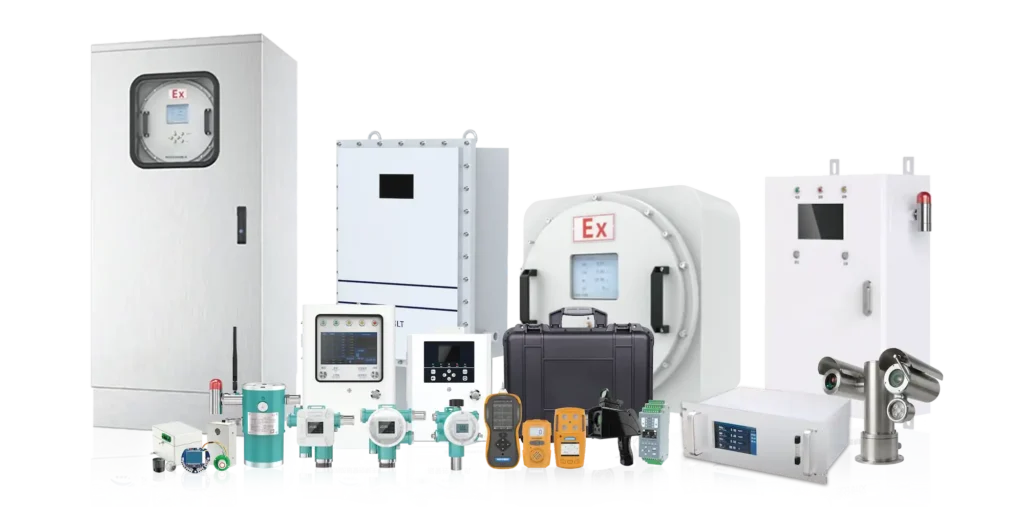
Fixed Gas Detectors
Fixed detectors are installed at selected locations to provide continuous monitoring.
They are suitable for applications requiring permanent gas monitoring, centralized alarms, or integration with facility control systems.
Potential advantages include continuous coverage of designated locations and integration with automated alarm responses.
Portable Gas Detectors
Portable instruments are carried by personnel for task-based monitoring, inspection, or entry into areas where atmospheric hazards may exist.
Depending on the model, portable detectors may monitor one gas or multiple gases.
They are particularly useful for maintenance activities and supplementary atmospheric checks.
Which Is Better?
For many industrial sites, fixed and portable detection serve complementary functions rather than replacing one another.
The appropriate combination depends on the installation layout, operating procedures, personnel exposure risks, and the project’s safety requirements.
6. Integrating Gas Detection with BESS Safety Systems
Gas detectors are most effective when their alarms trigger a clearly defined response.
Depending on the system architecture, gas detection equipment may interface with:
- Battery management systems (BMS).
- Energy management systems (EMS).
- Programmable logic controllers (PLC).
- Supervisory control and data acquisition (SCADA) systems.
- Fire alarm and emergency response systems.
- Remote monitoring and facility management platforms.
The project team should define alarm levels, signal handling, fault reporting, communication-loss behavior, and escalation procedures during system design.
Any automatic action, such as ventilation activation, equipment shutdown, or emergency isolation, must be engineered and validated for the specific installation. Gas detection signals should not be assumed to provide a universal control strategy for every battery system.
Commissioning should verify detector response, alarm transmission, control-system integration, and the documented cause-and-effect sequence.
7. Common Mistakes When Designing BESS Gas Detection
Several common design issues can reduce the effectiveness of a gas detection system.
Choosing sensors without a defined detection objective. A detector suitable for combustible gas monitoring may not be suitable for toxic gases or battery off-gas analysis.
Using the same detector layout for every battery container. Enclosure design, ventilation, battery chemistry, and gas release scenarios can differ significantly.
Ignoring sensor cross-sensitivity. Some sensors respond to more than one substance. These effects must be evaluated when selecting the detection technology.
Overlooking environmental conditions. Temperature, humidity, contamination, and corrosive gases may affect sensor performance and service life.
Failing to define alarm responses. Detection alone is not a complete safety strategy. Operators need documented procedures for alarm verification, escalation, and emergency response.
Neglecting commissioning and maintenance. Functional checks, calibration where required, fault monitoring, and maintenance records are essential to long-term reliability.
8. A Practical Checklist for BESS Gas Detection Projects
Before selecting or specifying equipment, project engineers should confirm the following:
- Battery chemistry and system configuration are documented.
- Credible gas release scenarios have been evaluated.
- Required target gases and detection objectives are defined.
- Sensor technology and measurement range are suitable.
- Detector locations have been reviewed against enclosure design and ventilation.
- Environmental and hazardous-area requirements have been checked.
- Communication interfaces and alarm outputs are confirmed.
- Alarm thresholds and response procedures are documented.
- Commissioning, testing, and maintenance requirements are established.
- The proposed solution is compatible with applicable codes, standards, and project specifications.
Conclusion: Building a Suitable Gas Detection Strategy for BESS
Gas detection can play an important role in battery energy storage safety by monitoring selected gases associated with abnormal battery conditions and other credible hazards.
The right solution depends on the battery technology, installation design, target gases, ventilation, environmental conditions, and required alarm functions.
For project developers, EPC contractors, system integrators, and BESS operators, the most effective approach is to define the detection objective first, select appropriate sensor technologies, plan detector locations carefully, and validate the complete alarm and monitoring system before commissioning.
HighSeek provides portable gas detectors, fixed gas detection solutions, and industrial monitoring options for different application requirements. For BESS projects, detector selection should be based on the specific target gases, environmental conditions, required interfaces, and applicable safety standards.
Planning a battery energy storage project?
Contact HighSeek to discuss your gas detection requirements, target gases, installation environment, and system integration needs.
Request a product recommendation or technical consultation for your BESS application.
Disclaimer: This article provides general technical guidance and is not a substitute for a project-specific fire and gas risk assessment, applicable regulations, or the battery system manufacturer’s safety instructions.